

 עברית
עברית


The route starts at Cafe Ritual, located on Route 85 in the Bar Lev industrial area.

The Norman Trail is located next to Kfar Vradim. The trail winds through a tiny, unpretentious wooded hill: there are no waterfalls, no pools of water, and no spectacular canyon. Just a hill, trees, and rocks, and yet the site is very special – as if the rocks had been waiting there for all these years for someone to come and discover their wonderful virtues. Indeed, the hand of a sensitive and talented artist has transformed the place into a fascinating creation.

Moti and Noa Ifrach, a couple in life and work, fulfilled their dream and set up Noalush ― bakery, deli, and restaurant, on the road connecting Tarshiha to Kfar Vradim. Moti, a graduate of the Cordon Bleu in Paris, produces a variety of French-style cakes, cookies, and pastries. At the deli and restaurant, his wife Noa collects and coordinates all the best products of Israel and the world. Among other things, you will find a wide variety of cheeses, smoked fish, wine, and specialty delicacies. At their restaurant, dishes are served based on the deli’s products and a rich and varied dairy menu.
Events can also be held there.
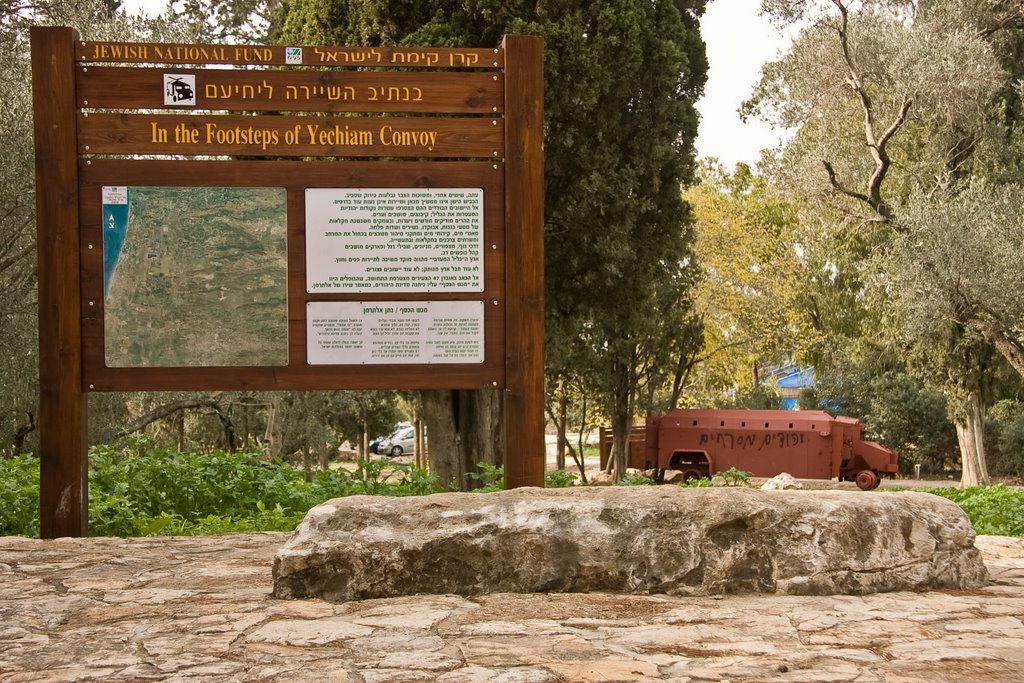
Located south of the Cabri Junction and east of Moshav Netiv HaShayara. The site commemorates the fallen of the Yehiam convoy and other fighters who fell in the breakthrough to Yehiam. In total, 70 fallen soldiers are commemorated at the site. The Yehiam convoy was a supply convoy of the Carmeli Brigade in the War of Independence that set out in 1948 from Nahariya to Kibbutz Yehiam. The convoy was ambushed and attacked by gangs. In the attack on the convoy, 46 fighters were killed.
In the 1960s, the Ga’aton Regional Council decided to build a reconstruction of the battle at the site where the convoy fell. The work was assigned to the sculptor Yechiel Shemi, a member of nearby Kibbutz Cabri. Shemi came to visit the area accompanied by architect Yechiel Arad, whose brother Moshe Plotzer fell in the convoy.
Arad planned the site around the old road – “Khishef HaBakshish”, right where the convoy fell. At the foot of the wall is a relief map of the battle and to the right of the wall is a section depicting the battle. On the sides of the road are scraps of armored vehicles. The site also includes an audio information stand in Hebrew and English, explanatory signs about the area in the period before and during the War of Independence, picnic tables and shaded seating areas among the trees.

